EdTech Partners

How to Add Embedded Payments to Your Education Platform

October 7, 2026

Schools increasingly want to take payments inside the systems they already use: fee billing in the MIS, trips and clubs in the booking system, lunches in the catering app. For the platforms behind those systems, embedded payments has moved from "nice to have" to something schools ask about in the first demo.

The question we hear most from product teams isn't whether to add payments. It's what's actually involved. Here's a practical walk-through.

What "embedded payments" actually means

Embedded payments means parents pay inside your product, rather than being sent off to a separate site or platform. The payment experience looks and feels like the rest of your platform, while a payments partner handles what happens after someone presses pay.

It's different from bolting on a payment gateway. A gateway takes the payment. An embedded payments partner also handles everything around it: onboarding schools, moving the money, reconciling it and supporting it.

Step 1: Decide where payments sit in your product

Start with the parent journey, not the technology. Where in your product does money change hands? A fee bill, a trip consent form, a club booking, a lunch top-up?

Then decide how it should look. Some platforms want payments fully white labelled. Others prefer co-branding, because schools and parents that already use esenda elsewhere find a familiar name reassuring. Neither is wrong, and the choice can differ by product.

Step 2: Map how your schools are structured

Schools aren't one simple customer. A trust or group might be several separately registered schools, and each legal entity may need to be verified before it can take a payment.

You'll also want to know where the money should land (which bank account, for which school) and how schools want it reported. Estates income, for example, may need to be kept separate. Getting this right up front saves a lot of untangling later.
Step 3: Choose your payment methods

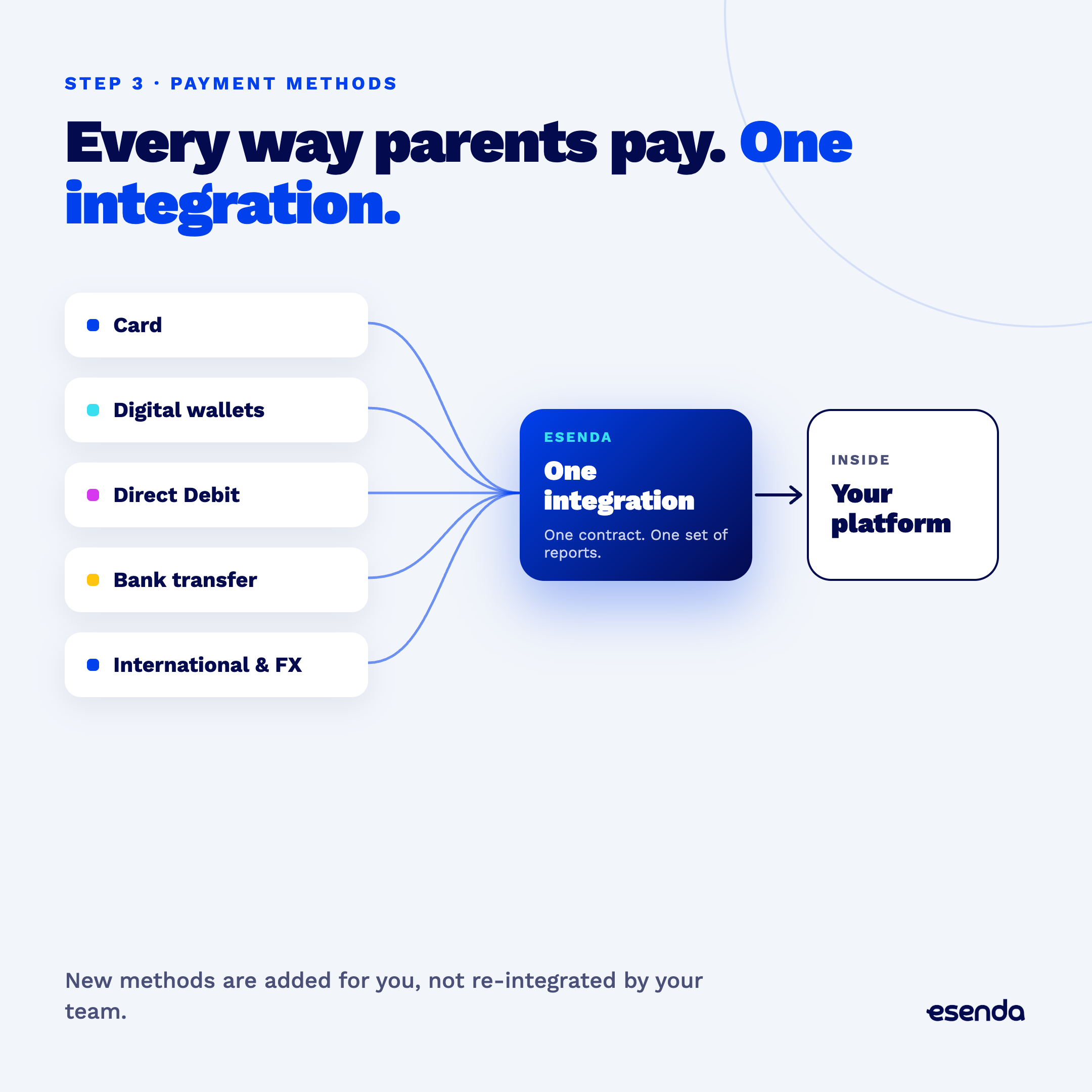
Parents don't all pay the same way. Card and digital wallets suit one-off payments. Direct Debit may suit termly fees and instalments. Bank transfer can be an option for large balances. International families need to pay in their own currency without the school losing out.

If you add these one provider at a time, you end up with a patchwork of contracts, reports and support routes. It's worth choosing a partner who covers all of them through one integration from day one.

Download PDF

Step 4: Integrate

With the right partner, the integration itself is painless. Typically you'll connect to an API and embed a checkout or payment links in your product.

Look for clear documentation, a sandbox to test in, and named people to talk to when you have questions. esenda's developer docs are at docs.esenda.com.

Step 5: Plan onboarding, reconciliation and support

This is where embedded payments either feels effortless or becomes a second job.

Onboarding: who verifies each new school, and how long does it take? With an education payments partner, this runs alongside your rollout rather than landing on your team.

Reconciliation: school finance teams need to match every payment to a pupil, a bill and a reference, in a format that survives an audit. Payments that arrive already identified save them hours, and save you the support tickets.

Support: when a parent can't pay, the school might call you. Know who you call next, and make sure it's someone who knows what a bursar, a bursary and a termly instalment plan are.

Step 6: Agree the commercials

For most platforms, payments show up as a cost line: a percentage that leaves the business every time a parent pays. It doesn't have to be.

A platform brings the schools, the product and the relationship. A payments partner brings the rails, the compliance and the expertise. With the right partner, payments can become a revenue stream that sits alongside your product income.

The short version

Adding embedded payments to an education platform comes down to six decisions: where payments sit, how your schools are structured, which methods to offer, how to integrate, who carries onboarding and support, and what the commercial model looks like.

esenda works deliberately with edtech partners, including iSAMS, WCBS, Furlong, SOCS and SchoolGrid, and has processed over £1.5bn in Direct Debit volume for schools through our partnership with WCBS.

Weighing up your options?  Contact our partnerships team here.

Related: Embedded Payments for EdTech: Surviving the September Surge

‍

Download PDF