Education

School fee payment fraud: how to spot and stop it
September 30, 2026

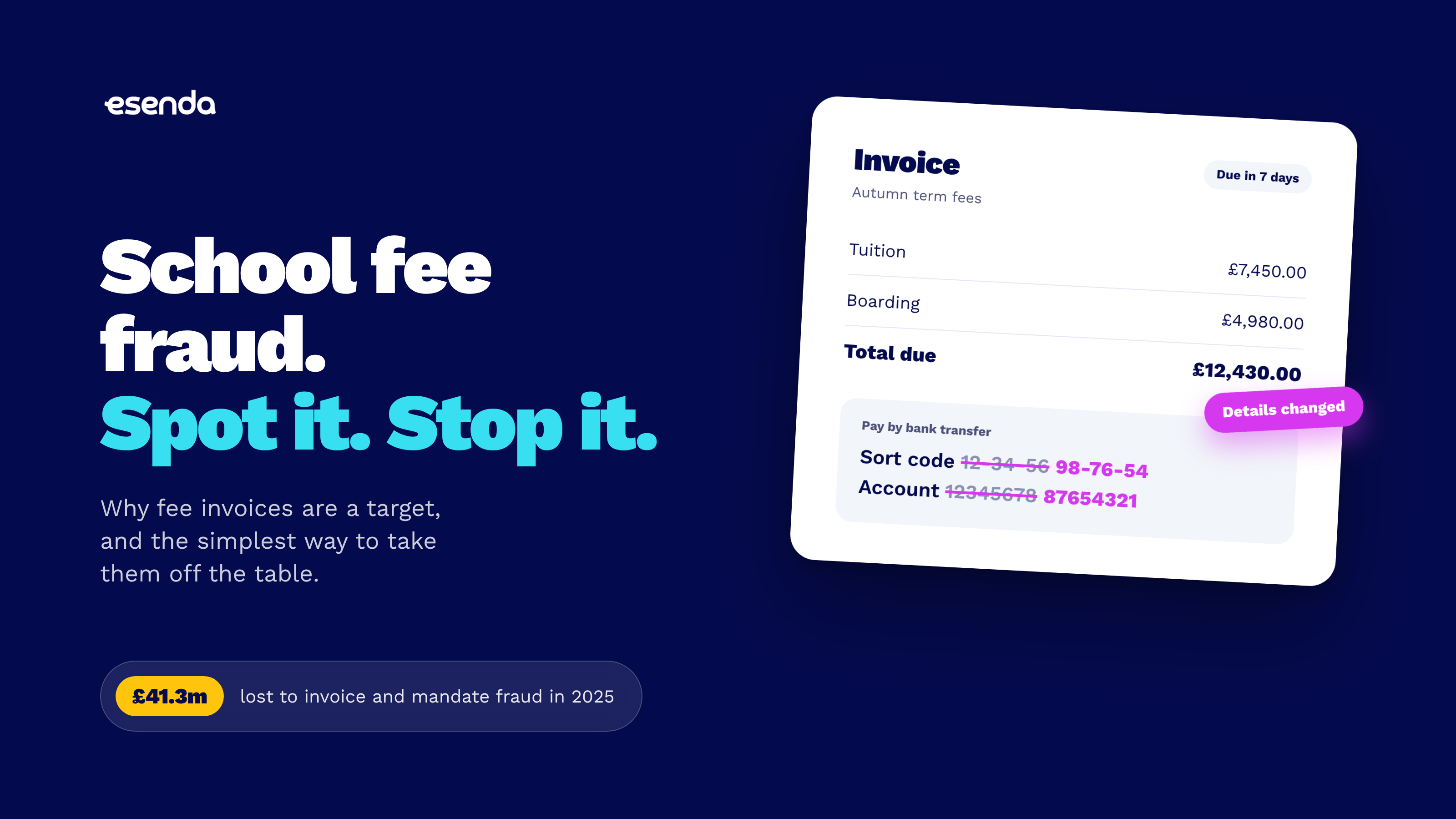
School fee payment fraud usually happens when a criminal intercepts or copies a school's invoice, changes the bank details, and sends it to parents. The parent pays what looks like a genuine bill, and the money goes to the fraudster instead of the school. The most effective way to stop it is to take bank details off invoices entirely and give parents a secure payment link instead.

What is school fee invoice fraud?

It is a form of authorised push payment (APP) fraud. The parent authorises the payment themselves, believing it is going to the school. In reality, it goes to an account controlled by a fraudster.

It often starts with a compromised or spoofed email. A parent receives what looks like a normal fee invoice, or a message saying the school has "changed its bank details". Everything looks right: the logo, the amount, the timing. Only the account number is different.

How common is invoice fraud?

According to UK Finance, £576.4m was lost to authorised push payment fraud in 2025, up 19% on the year before.

£41.3m of that was invoice and mandate fraud, across 2,305 cases. This is the category that school fee scams fall into.

Why are school fee invoices a target?

A school fee invoice fits the fraud pattern almost exactly. It is:

  • Large. Fees run to thousands of pounds a term, so a single successful scam is worth a lot.
  • Expected. Parents know the bill is coming and when, so an invoice arriving by email raises no suspicion.
  • Paid to an account the family rarely uses. Most parents don't recognise the school's bank details from memory, so a changed number is easy to miss.

Published account details are the weak point. Anything printed on an invoice can be copied, altered and resent before a parent ever sees the real one.
‍

What are thewarning signs of a school fee scam?

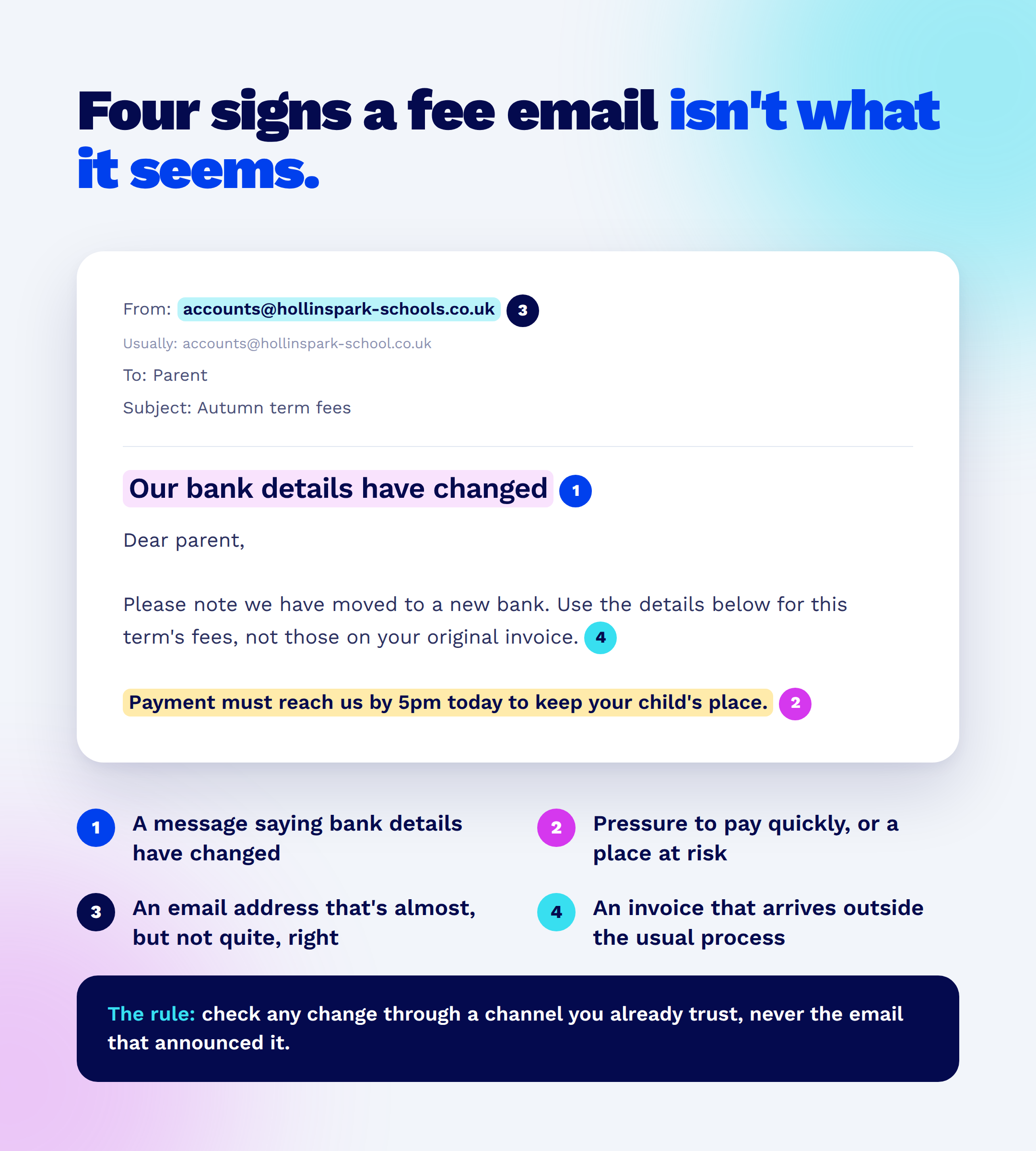
Parents and finance teams should be wary of:

  • A message saying the school's bank details have changed, especially by email.
  • Pressure to pay quickly, or a warning that a place is at risk if payment isn't made today.
  • A slightly different email address from the one the school normally uses.
  • An invoice that arrives outside the usual process, or from someone the parent doesn't normally hear from.

A school changing its bank details is rare. When it happens, the change should always be confirmed through a channel the parent already trusts, never through the email that announced it.

Download PDF

What happens if a parent pays a fraudster?

Bank transfer carries the least protection of any payment method. There is no chargeback, and Section 75 protection only applies to credit cards, never to a transfer.

Getting the money back is far from guaranteed. In 2025, 48% of invoice and mandate fraud losses were returned to victims, the second lowest of the eight scam types UK Finance tracks. The rest was lost.

For the school, the fees are still unpaid. That leaves a family out of pocket, an awkward conversation, and a balance that may never be recovered.

How can schools prevent school fee fraud?

The goal is to remove the thing fraudsters rely on: bank details that can be copied and changed.

Take bank details off invoices

The safest invoice carries no bank details at all. If there is no account number to intercept, there is nothing to alter. A payment link on the invoice does the same job, without the risk.

Host your payment link on your website

Publish your payment route on your own website, say clearly which payment provider you use, and link to it from there. Parents then have one trusted place to pay, and can always check it independently of any email.

Offer methods that verify who is being paid

Card, Direct Debit and open banking all confirm the payee before money moves. That makes them much harder to redirect than a manual bank transfer, where the parent types in whatever details they have been given.

Reconcile quickly

When payments reconcile automatically, a missing payment shows up within days rather than at the end of term. The sooner a school spots that a family's payment hasn't arrived, the sooner both sides can act, while there is still a chance of recovering the money.

Tell parents what you will never do

A single clear line in every fee communication helps, for example: "We will never ask you to change payment details by email." It gives parents a simple rule to check any message against.

What should a parent do if they think they've been targeted?

Contact their bank straight away, using the number on the back of their card or by calling 159, the UK's secure line to reach a bank's fraud team. Then contact the school using a phone number or website they already know, not the details in the suspicious email.

Speed matters. The quicker the bank is told, the better the chance of stopping or recovering the payment.

Frequently asked questions

What is school fee fraud?
School fee fraud is when a criminal sends parents a fake or altered fee invoice with changed bank details, so the payment goes to the fraudster instead of the school. It is a type of authorised push payment fraud.

How much is lost to invoice fraud in the UK?
£41.3m was lost to invoice and mandate fraud in 2025, across 2,305 cases, according to UK Finance. Total authorised push payment fraud losses were £576.4m.

Can parents get their money back after an invoice scam?
Sometimes, but not always. In 2025, 48% of invoice and mandate fraud losses were returned to victims. Bank transfers have no chargeback, and Section 75 protection only covers credit card payments.

What is the safest way to pay school fees?
Methods that verify the payee before money moves, such as card, Direct Debit or open banking, through a payment link from the school's own website. These are much harder to redirect than a manual bank transfer.

Should schools put bank details on invoices?
Ideally not. Anything printed on an invoice can be copied and changed. A payment link removes the bank details altogether, so there is nothing for a fraudster to alter.

‍

Download PDF