Should schools run their own payment plans?
More families are asking to spread the cost of fees. For many, a single termly payment is simply harder to manage than it used to be, and paying monthly makes the difference between staying and leaving.
Most schools want to help. The question is how.
Why are more families asking to pay monthly?
School fees are one of the biggest payments many families make each year. When household budgets are under pressure, paying a large termly bill in one go becomes harder, even for families who are fully committed to the school.
Monthly payments spread that cost into something more manageable. For schools, saying yes can protect enrolment and keep good families at the school.
What does it cost a school to run payment plans in-house?
On paper, a school-run payment plan looks simple: the family pays in instalments instead of all at once. In practice, the school takes on three things.
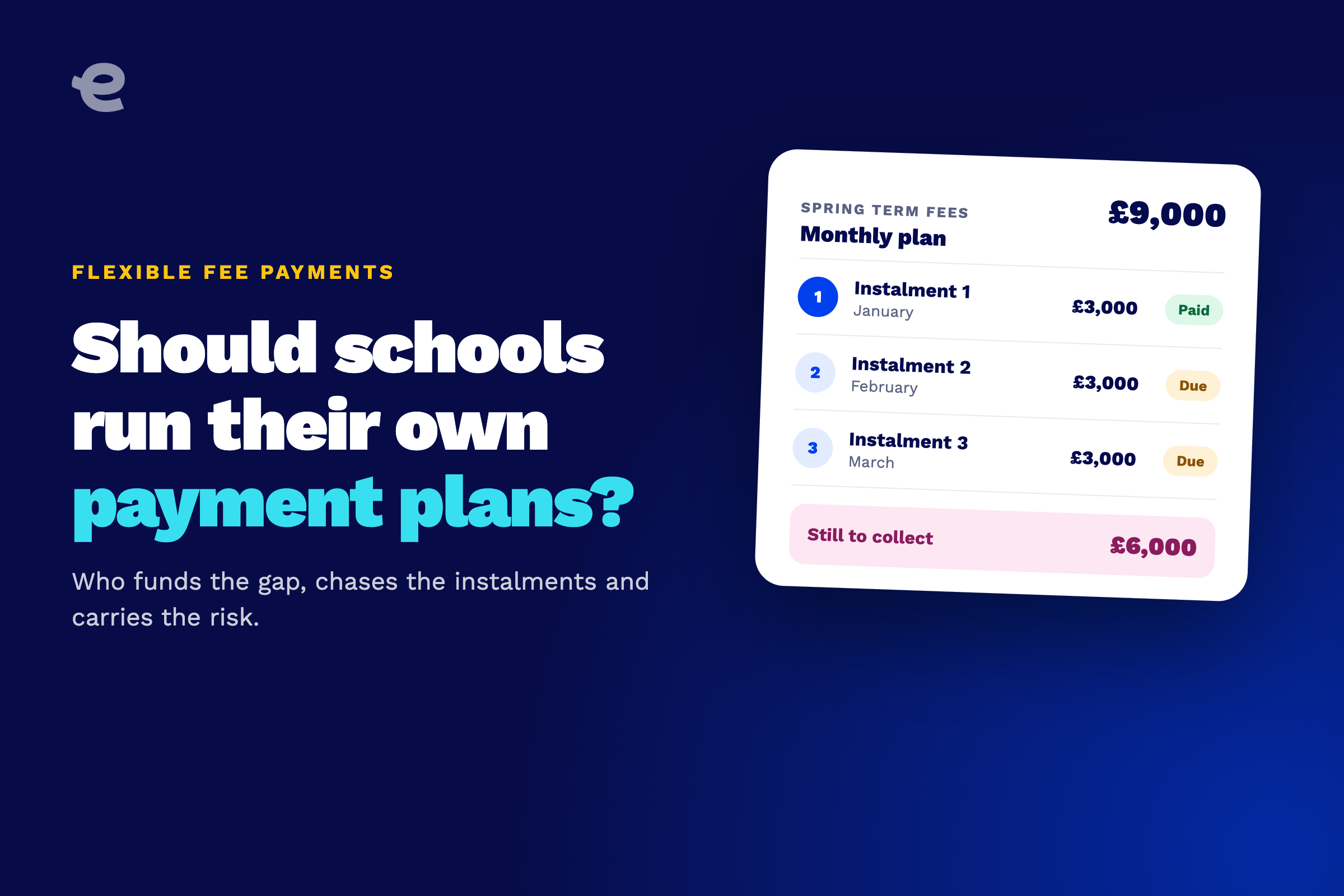
The cash-flow gap. If a £9,000 term fee is split over three months, the school receives £3,000 on day one. The other £6,000 arrives later, but the school’s costs don’t wait. The school is effectively funding the gap.
The admin. Every instalment needs setting up, tracking, reconciling and, too often, chasing. Multiply that across many families and several terms, and it becomes a real workload for the finance team.
The risk. If a family stops paying partway through, the school has already provided the education. Recovering the money is slow, uncomfortable and not always successful.
There’s also a regulatory point to be aware of. If a school-run plan charges interest or fees, it may fall under consumer credit rules, so it’s worth checking your position with your advisers.
What are the alternatives to school-run payment plans?
Schools have several ways to give families flexibility. Each works differently, and each puts the cost and risk in a different place.
School-run payment plans
The school offers instalments itself.
- Good for: maximum control, and a personal approach for individual families
- Watch out for: the school funds the gap, handles the admin and carries the risk of non-payment
Provider-run payment plans
A specialist provider runs the plan. The family spreads the cost, while the school is paid on an agreed schedule.
- Good for: flexibility for families without the cash-flow gap or the chasing
- Watch out for: check how and when the school is paid, and what the experience is like for parents
Fee finance from credit lenders
A lender pays the school and the family repays the lender over time.
- Good for: the school receives the fees upfront
- Watch out for: families take on credit, often with interest, and some arrangements involve the school in the lending relationship
Lender commission arrangements
Some fee finance products pay the school a commission or carry fees linked to the school.
- Good for: a possible income stream
- Watch out for: it can be harder to explain to families, and the school’s role in the credit arrangement needs careful thought
Annual or termly discounts for paying upfront
The school offers a discount to families who pay in one go.
- Good for: bringing cash in early and rewarding families who can pay upfront
- Watch out for: it helps families who already can, rather than those who need flexibility
