Education

Spring Term Bill Run Checklist for School Bursars
October 13, 2026

Spring term bill run checklist: 5 checks for bursars before fees go out

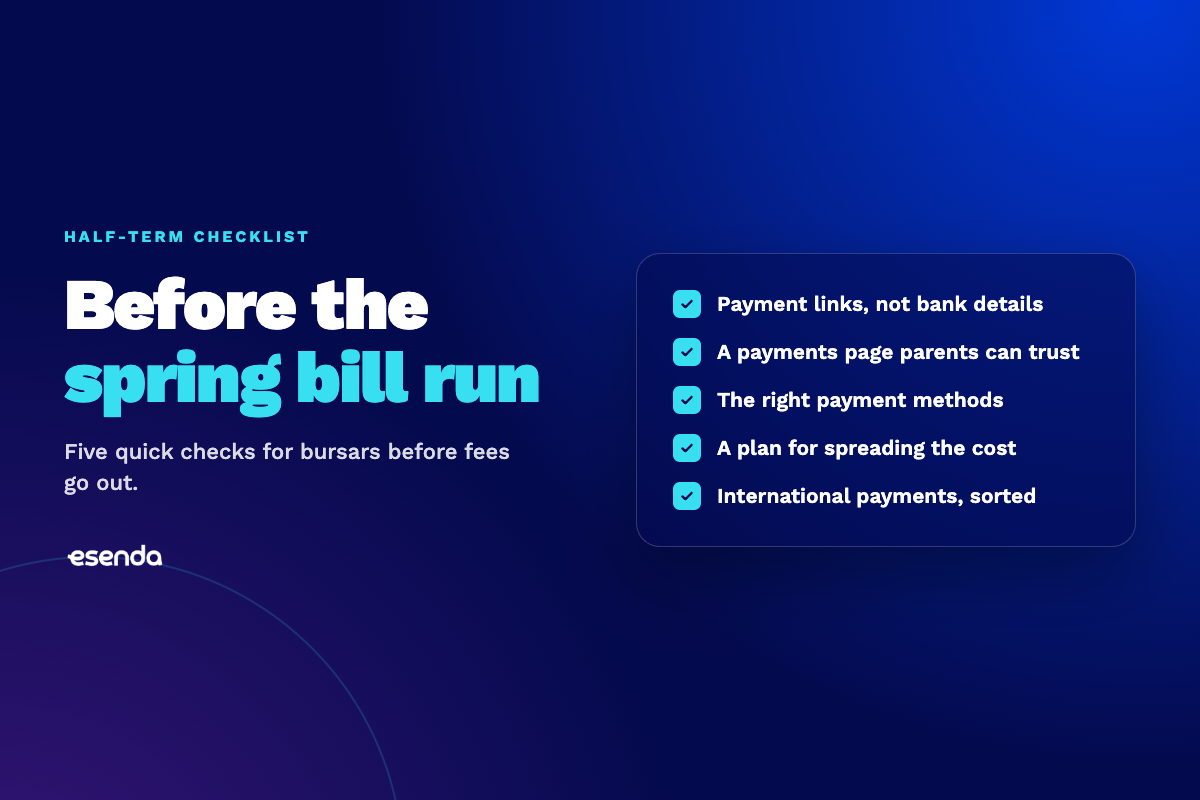
Quick answer: Before your spring term fee invoices go out, bursars should check six things: (1) replace bank details on invoices with a secure payment link, (2) publish a payments page on the school website, (3) review which payment methods families can use and how each protects them, (4) decide how families can spread the cost, (5) make international payments simple and complete Together, these reduce fraud risk, late payments and January admin.

6 minute read · For bursars and school finance teams

Half term is a rare breathing space in the autumn. It’s also the last calm moment before spring term invoices go out, usually in November or December.

A few small changes now can save weeks of chasing in January. None of these needs a new system or a big project, and most take less time than a cup of tea.

Why should schools review fee collection before the spring bill run?

The spring bill run is the right moment because it’s the next point at which every family receives an invoice. Any change you make now, whether a new payment method, clearer wording or a payment link, reaches every family at once, before problems have a chance to repeat.

It also matters more than it used to. Fees have risen for every family since VAT was added to independent school fees in January 2025. The 2026 ISC Census shows pupil numbers down 3.5% in a year. Every family a school keeps matters, and so does how easy fees are to pay.

1. Should schools put bank details on fee invoices?

No. The safest fee invoice carries no bank details at all. Use a secure payment link instead.

A fee invoice is large, expected and arrives by email, which is exactly the pattern invoice fraud relies on. A criminal intercepts or copies the invoice, changes the account details, and the parent pays the wrong account without realising.

  • UK Finance reports £41.3 million was lost to invoice and mandate fraud in 2025, across 2,305 cases.
  • Only 48% of those losses were returned to victims.

A payment link takes parents into a payment journey your school controls, so there’s nothing on the invoice worth intercepting or editing.

2. How can parents check a fee payment request is genuine?

Give them a trusted place to check: a payments page on your own school website.

A short, permanent payments page should:

  • say who collects your school fees
  • link to your payment provider
  • explain what parents should expect, including the name on the account they pay into if it’s your provider’s rather than the school’s
  • say what the school will never ask parents to do, such as pay a “new” account by email

The account name point matters. An unfamiliar name is one of the most common reasons a careful parent pauses, or their bank runs extra checks. Explaining it up front stops the query before it reaches your office.
‍

What paymentmethods should schools offer for fees?

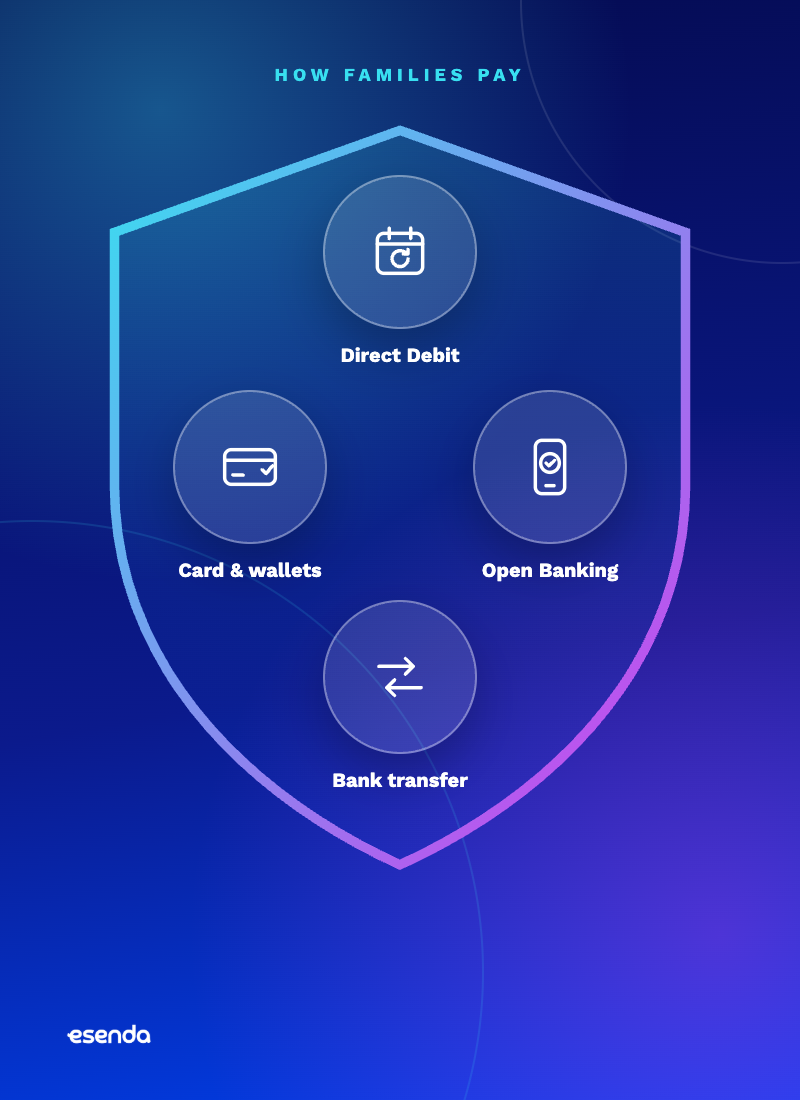
Most schools are best served by Direct Debit as the base, with card, digital wallets and Open Banking alongside it. Each method moves money differently and protects parents differently.

Direct Debit

  • When the school is paid: on a set date, via the Bacs cycle
  • Protection for parents: the Direct Debit Guarantee
  • Best for: termly fees and instalments

Card and digital wallets

  • When the school is paid: in full, and any debt sits with the card provider rather than the school
  • Protection for parents: chargeback, plus Section 75 on credit card payments between £100 and £30,000
  • Best for: flexibility and one-off payments

Open Banking

  • When the school is paid: instantly
  • Protection for parents: the parent approves the payment in their own banking app, with the school’s details already filled in
  • Best for: fast, low-cost one-off payments

Bank transfer

  • When the school is paid: whenever the parent sends it
  • Protection for parents: some basic protection, with no chargeback
  • Best for: large one-off payments, used with care

If bank transfer is still your main route for fees, the spring bill run is a good moment to offer at least one alternative.

Download PDF

4. How can schools let families spread the cost of fees?

There are four common ways, and each has different trade-offs for the school. The key question is who carries the gap between when costs fall due and when fees arrive.

School-run payment plans

The most common starting point. Flexible and familiar, but the school funds the gap, carries the risk if a family stops paying, and takes on the tracking and chasing. If a plan charges interest or fees, it may fall under consumer credit rules, so check with your advisers.

Payment plan providers

A specialist provider manages the plan on the school’s behalf. Families spread the cost weekly, fortnightly or monthly, and the school is paid in full on an agreed schedule, without carrying the gap or the admin.

Card payments

Parents use their own credit to spread the cost on their own terms, at no cost or risk to the school.

Parent-arranged finance

Families apply for finance themselves, without the school’s time, cost or involvement.

‍

Most schools offer a mix. Families who can pay up front do; families who need flexibility have it, without the school becoming a lender.

Explore this in depth at our free webinar with Edstart: Flexibility without the admin: rethinking how school fees get paid

5. How should schools prepare for international fee payments?

Make sure overseas families can pay easily from their own country, that the school receives the full amount due, and that every payment arrives identified.

The 2026 ISC Census shows pupils with parents living overseas fell 10.1% in a year, around three times faster than the sector as a whole. Each international family is now harder to win and more valuable to keep, so a failed or short payment becomes a retention issue, not just an admin one.

Read the full research: The Overseas Intake

‍

Spring term bill run checklist

  • Replace bank details on invoices with a secure payment link
  • Publish or update a payments page on your website
  • Review which payment methods families can use
  • Decide how families can spread the cost
  • Make international payments simple and complete

Small changes now mean a calmer January for your finance team and a smoother experience for every family.

Need a hand with any of these? We can help you set up payment links, a payments page or a quick review before the spring bill run.

Download PDF